community
1 Results Found
 🖼️ 1
🖼️ 1
Data Modeling is not one activity: Conceptual, Logical and Physical Models
$0
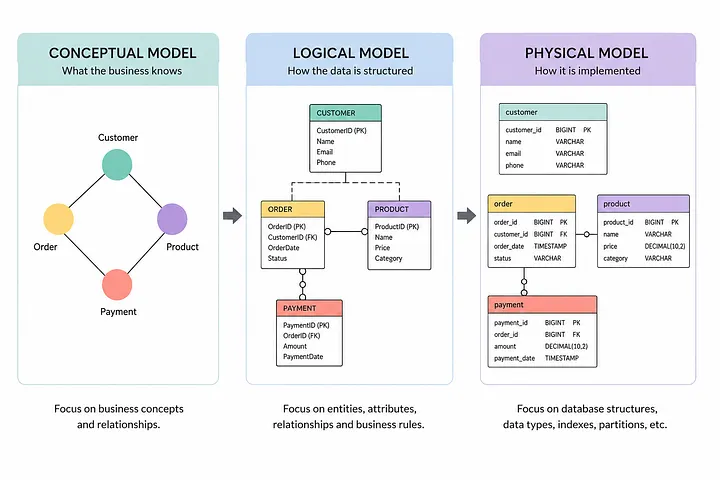
A deep dive into conceptual, logical, and physical data modeling, explaining key decisions, outputs, and an optimal end-to-end process for building scalable and maintainable data systems.If you’ve worked in data for a while, you’ve probably seen this pattern:Someone says “we need a better data model”, and the conversation immediately drifts into tables, columns, or tooling decisions.But “data model” is not a single artifact. It is actually three different layers of abstraction that solve three very different problems. When teams collapse them into one, the result is almost always the same: confusion in business definitions, fragile schemas, and models that are difficult to evolve without breaking everything downstream.The distinction between conceptual, logical, and physical modeling is not academic. It is what allows a data platform to remain understandable after it scales.The Three Models Exist for One Reason: Separation of ConcernsEach modeling phase answers a completely different question, and that separation is intentional.The conceptual model answers: what exists in the business?The logical model answers: how is that information structured?The physical model answers: how is it implemented efficiently in a specific system?The key mistake most teams make is trying to answer more than one of these questions at the same time.When that happens, business discussions get polluted with technical constraints, and technical design gets polluted with business ambiguity.Good modeling is not about complexity. It is about keeping concerns isolated long enough for each of them to be solved properly.